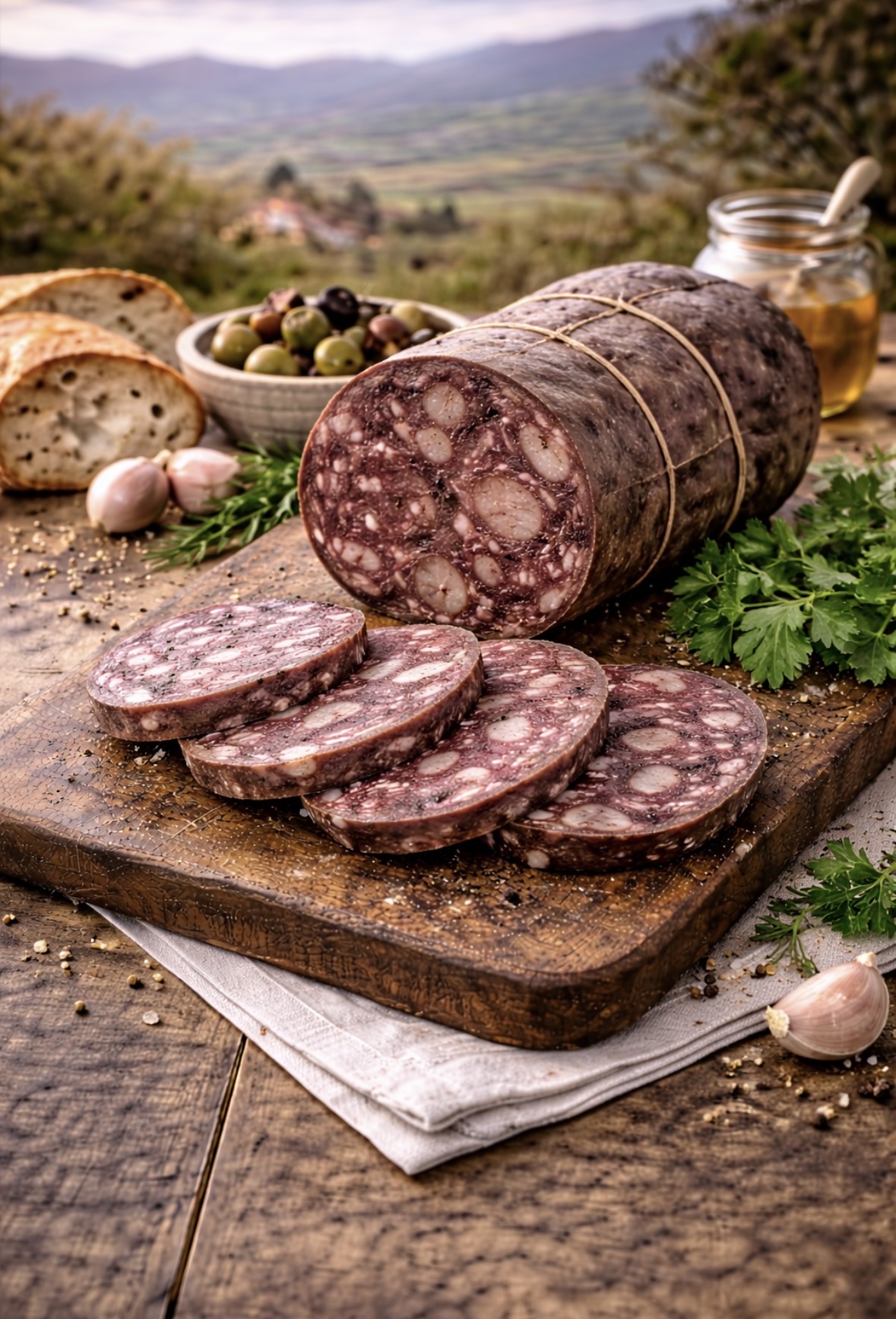
Buristo fiorentino

Local souvenir

Buristo fiorentino

Florence
€10-€22 gastronomia

Local souvenir · Florence

Buristo is a traditional Tuscan cured meat made with pig’s blood, spices, raisins, pine nuts, and bread. It has a firm texture, a dark color, and an intense flavor. It is not a refined product, nor is it meant to appeal to everyone. It is a food tied to домаш slaughter and rural cooking, where nothing was wasted and every part of the animal was used. It is eaten sliced, often cold, as part of a platter or a savory snack. It is a direct, bold food, without mediation. It tells the story of a practical cuisine, connected to necessity, respect for ingredients, and the completeness of the gesture.

Editorial team: Trouvenir

Published: 15 gennaio 2026

Updated: 15 marzo 2026

"

Buristo represents a food culture based on completeness and respect for resources. It originated in a context where every ingredient was valued and nothing was wasted. It reflects a practical, attentive mindset, little inclined toward excess, where cooking was above all about management, balance, and continuity. It is not a food of display, but of everyday life. In this sense, buristo expresses a culture that does not separate what is easy from what is complex, but holds them together. A cuisine that does not select, but integrates.

Trouvenir recommends
Tradizione contadinaDa assaggiareEsperienza autenticaSapori intensi

Description

Buristo is a traditional Tuscan cured meat made with pig’s blood, spices, raisins, pine nuts, and bread. It has a firm texture, a dark color, and an intense flavor. It is not a refined product, nor is it meant to appeal to everyone. It is a food tied to домаш slaughter and rural cooking, where nothing was wasted and every part of the animal was used. It is eaten sliced, often cold, as part of a platter or a savory snack. It is a direct, bold food, without mediation. It tells the story of a practical cuisine, connected to necessity, respect for ingredients, and the completeness of the gesture.

History and origin

Buristo comes from the tradition of home pig slaughter, widespread in the Tuscan countryside until a few decades ago. During this moment—considered essential for the family economy—nothing was thrown away. The blood, collected immediately after the animal was slaughtered, was mixed with spices, raisins, pine nuts, bread, and broth, following recipes that varied from place to place and from family to family. The mixture was then stuffed into casings and cooked. This was not an occasional preparation but a specific stage in the process of working the pig. Buristo was part of the complete use of the animal, alongside cured meats, sausages, and hams. Its origin is therefore linked to a cuisine of necessity, thrift, and respect for ingredients, more than to a search for taste or refinement.

Cultural significance

Buristo represents a food culture based on completeness and respect for resources. It originated in a context where every ingredient was valued and nothing was wasted. It reflects a practical, attentive mindset, little inclined toward excess, where cooking was above all about management, balance, and continuity. It is not a food of display, but of everyday life. In this sense, buristo expresses a culture that does not separate what is easy from what is complex, but holds them together. A cuisine that does not select, but integrates.

FAQs

Che cosa rende autentico Buristo fiorentino?

Buristo represents a food culture based on completeness and respect for resources. It originated in a context where every ingredient was valued and nothing was wasted. It reflects a practical, attentive mindset, little inclined toward excess, where cooking was above all about management, balance, and continuity. It is not a food of display, but of everyday life. In this sense, buristo expresses a culture that does not separate what is easy from what is complex, but holds them together. A cuisine that does not select, but integrates.

Dove trovare Buristo fiorentino a Florence?

📍 In Firenze and surroundings: • historic butcher shops • traditional norcinerie • neighborhood markets (Sant’Ambrogio, San Lorenzo) • village food shops

Quanto costa Buristo fiorentino?

€10-€22

Perche scegliere Buristo fiorentino come regalo?

Perche racchiude una storia locale e un valore culturale riconoscibile.

Other souvenirs in Florence

Learn more

Where to find it

📍 In Firenze and surroundings: • historic butcher shops • traditional norcinerie • neighborhood markets (Sant’Ambrogio, San Lorenzo) • village food shops

✦ Botteghe locali a Florence ✦

I migliori negozi per trovare Buristo fiorentino

Piccoli negozi, laboratori e punti vendita dove il souvenir mantiene un legame chiaro con il territorio.

4 shops consigliate 4 con coordinate disponibili
4 shops in mappa Apri mappa ↗
Erboristeria Officina De' Semplici
Storico Nome che richiama un'officina di rimedi naturaliSpecializzazione in 'semplici' (erbe officinali)

Erboristeria Officina De' Semplici

Viale Giuseppe Mazzini, 7/R, 50132 Firenze FI, Italy

Il negozio fisico "Erboristeria Officina De' Semplici", situato in Viale Giuseppe Mazzini, 7/R, 50132 Firenze FI, Italia, è esplicitamente identificato come un'erboristeria in diverse fonti online. Una descrizione dettagliata dei prodotti offerti include "Prodotti e cosmetica naturali, erbe biologiche, Ayurveda, micoterapia, fitoterapia di medicina tradizionale cinese, Fiori di Bach californiani e australiani". Questo conferma la vendita di "Prodotti officinali/erboristici".

Directions Google Place
Faggiola Latte e Formaggi Clai sca
Storico Nome include 'Latte e Formaggi'Situato nel Mugello

Faggiola Latte e Formaggi Clai sca

Località Quadalto, 57/B, 50035 Palazzuolo sul Senio FI, Italy

Il negozio "Faggiola Latte e Formaggi Clai sca" a Palazzuolo sul Senio è un produttore di formaggi locali e tipici toscani, situato nella regione del Mugello. La produzione si concentra su formaggi a base di latte vaccino di montagna e, in alcuni casi, di latte ovino. Sebbene venga menzionato l'utilizzo di caglio caprino per il "Canestrello Toscano Faggiola", il formaggio stesso è specificamente indicato come prodotto con latte vaccino. Non sono state trovate menzioni esplicite di "Formaggi di capra del Mugello" o di altri formaggi di capra tra i loro prodotti.

Directions Google Place
The Farm Palagiaccio
Storico Azienda agricolaSituato nel Mugello

The Farm Palagiaccio

Senni-San Carlo, 40, 50038 Scarperia e San Piero FI, Italy

La Storica Fattoria Il Palagiaccio, situata a Senni-San Carlo, 40, 50038 Scarperia e San Piero FI, Italia, vende formaggi prodotti in loco. Tra i loro prodotti, è esplicitamente menzionato un "Caprino" e un "Nuovo Formaggio 3 Latti" che è un "Formaggio a pasta morbida con latte vaccino, caprino e ovino". La fattoria è un'eccellenza del territorio mugellano nella produzione casearia, confermando l'origine locale dei formaggi di capra.

Directions Google Place
Erboristeria Gremoni
Selezionato Negozio specializzatoProdotti erboristici

Erboristeria Gremoni

Via Faenza, 101R, 50123 Firenze FI, Italy

L'Erboristeria Gremoni, situata in Via Faenza, 101R, 50123 Firenze FI, Italy, vende chiaramente "Prodotti officinali/erboristici". È descritta come un'antica erboristeria, la cui forza risiede nelle tisane e nelle erbe officinali, sia nazionali che estere, e nei loro derivati, come compresse, estratti, tinture e oli essenziali. Le recensioni dei clienti menzionano la varietà di prodotti erboristici e la competenza nella preparazione di miscele di erbe per tisane.

Directions Google Place
App Trouvenir

Porta Buristo fiorentino a casa con l'aiuto dell'app

Scarica Trouvenir per confrontare shops, trovare souvenir locali a Florence e salvare idee regalo in viaggio.

App Store Google Play Scarica Trouvenir