 €150-€2000
Florentine goldsmithing in Florence
AI summary
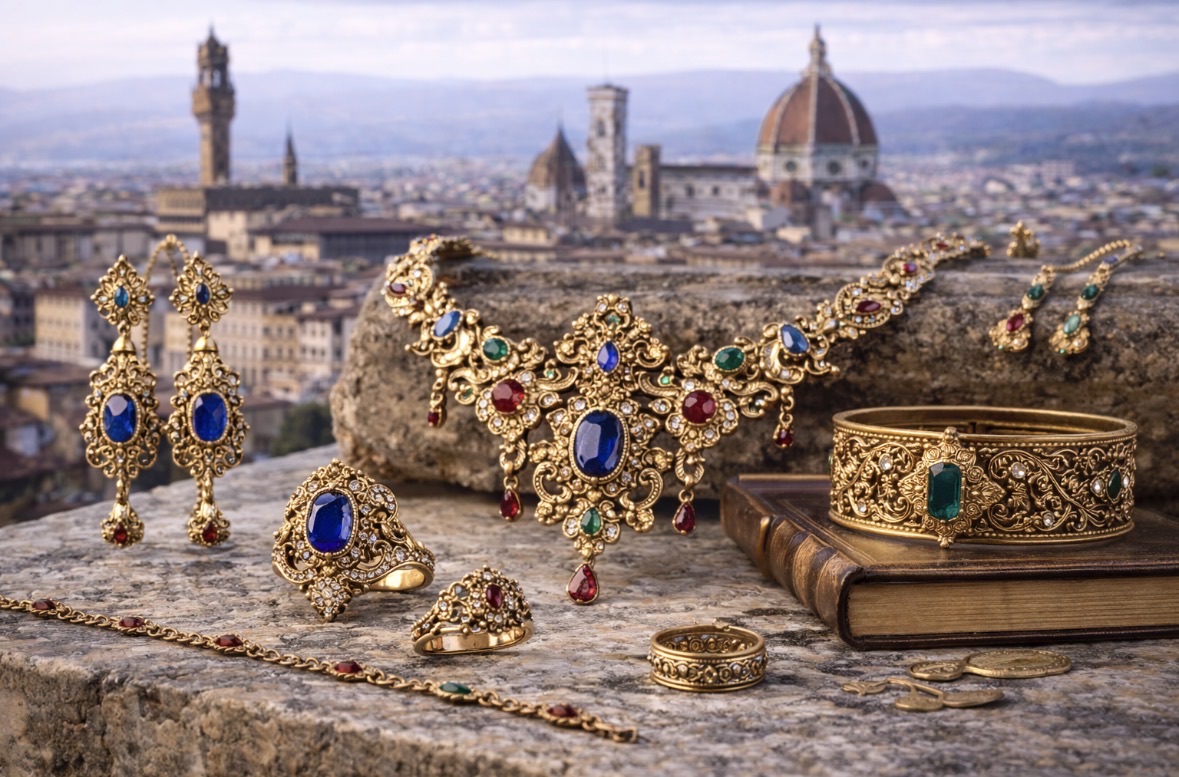
Florentine goldsmithing expresses a disciplined beauty, where gold is not meant to astonish but to achieve balance. Born in medieval workshops and still preserved today between Ponte Vecchio and the Oltrarno, this tradition unites skilled hands, a trained eye, and a Renaissance sense of proportion. Each jewel is designed with measure and precision, elegant without being ostentatious. Bringing one home means carrying a fragment of Florentine culture: refined, quiet, and deeply aware of form.
- Fatto a mano
- Tradizione secolare
- Da regalare
- Pezzo unico
Editorially verifiedartigianato
Verified shops arrive in the app
More crafts from Florence
The product
What Florentine goldsmithing is
Goldsmithing in Florence was not born to shine. It was born to measure.
The Florentine jewel is controlled, precise, structured. It does not seek spectacle, it avoids excess, it does not play with theatricality. It is planned, drawn, constructed.
Here, gold is not display. It is disciplined matter.
Rings, bracelets, necklaces, brooches, cameos, small objects in precious metal follow a logic: balance between form and function, between decoration and structure.
The Florentine signature is: • clean • measured • proportioned • never baroque • never loud
Even when it is rich, it remains composed.
The roots
Origin and history
Goldsmithing in Florence was not born from a desire for luxury. It was born from a need for measure.
In a city that has always believed the world could be regulated, designed, and controlled, even precious metal was treated as a material to be trained, not flaunted.
From the Middle Ages, Florence organized gold work within precise rules, guilds, and apprenticeships. One did not become a goldsmith through spontaneous talent, but through training. You learned to master the gesture before the material itself.
The hand was trained. The eye educated. Taste carefully guided.
When the Medici moved the goldsmiths’ workshops onto Ponte Vecchio, it was not an aesthetic gesture. It was a political and cultural one. They wanted order, decorum, control. They wanted commerce to be composed, production to be visible but not chaotic.
In Florence, gold has always existed within a frame.
It has never exploded. It has never overflowed. It has never become excess.
This created a precise style: elegant without being showy, rich without being loud, refined without being fragile.
Across the centuries, Florentine goldsmithing has never lost this line. Even when the world changed, when fashion shifted, when taste elsewhere became more theatrical, Florence remained faithful to its sense of measure.
It did not invent. It refined.
It did not break. It continued.
That is why even today, when you step into a Florentine goldsmith’s workshop, it does not feel like entering a shop. It feels like entering a continuity.
A gesture that has not been interrupted. A hand that has not stopped. A form that has not been betrayed.
Where to buy
Where to find Florentine goldsmithing in Florence
📍 Key area: Ponte Vecchio
Ponte Vecchio is historically the center of Florentine goldsmithing. It is not a coincidence, not marketing: it is a medieval continuity.
Beyond the bridge: • goldsmith workshops in Oltrarno • studios in Santa Croce • small artisans in the historic center
The real workshops: • still work at the bench • do repairs • create custom pieces • do more than just display windows
Often the workshop is behind the counter.
Get the full verified list - map, hours, reviews - for Florentine goldsmithing in Florence.
Free download
Take Trouvenir with you
iOS and Android. Free.
Privacy-firstCross-device syncOffline ready