 €10-€150
Florentine artistic reproductions (prints, engravings, and plaster casts)
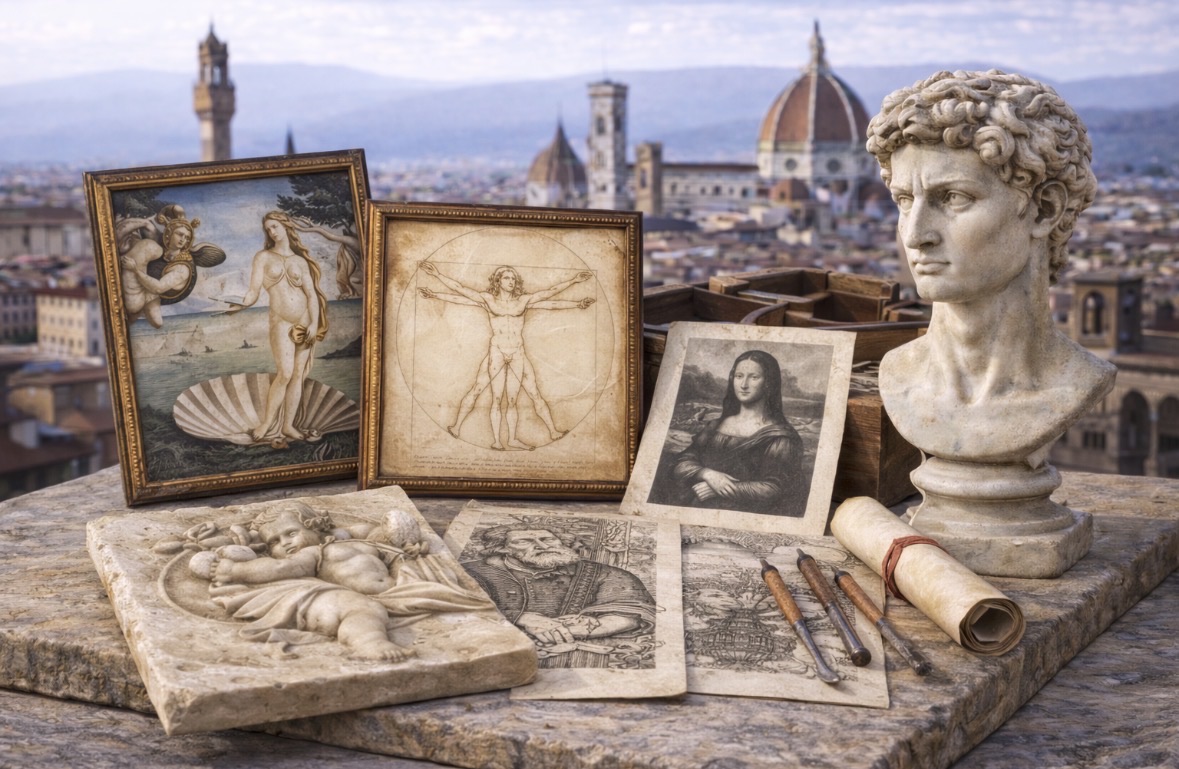
In Firenze, artistic reproduction is not conceived as a simple decorative copy, but as a way of bringing the form of art closer to everyday life. Intaglio prints, engravings, and small plaster casts reproduce details from famous works, Renaissance sculptures, or ornamental motifs studied in academies. These objects maintain strong attention to faithful proportions and materials, often created using traditional printing or modeling techniques. They may be press-printed engraved sheets, small busts, or sculptural fragments intended for study and observation. Rather than spectacular souvenirs, they are quiet presences that bring art into the home or studio.
3 verified shops curated by our editors
Why it's the ideal souvenir
Choosing a print or a small cast in Firenze means bringing home not only the image of an artwork, but the method through which art has been studied and transmitted for centuries. It is a souvenir particularly suited to those who enjoy observing details: the hand of a statue, a classical face, an engraved plate revealing the mark of the artist and the press. It takes up little space, fits naturally into a home or studio, and continues to reveal something each time you look at it. For those who visit the city’s museums and churches, these objects become a tangible memory of the forms encountered during the journey. It is also a way to support workshops and studios that keep artisanal techniques tied to the history of art alive.
The message it carries
This object reminds us that in Firenze, art is not only meant to be contemplated but also studied and approached closely. The forms of great masterpieces can circulate, be observed up close, and become part of everyday life. It carries the idea that beauty is learned through repetition and attention to detail.
Origin story
The spread of artistic reproductions in Firenze began during the Renaissance, when drawing and copying became fundamental tools of learning in workshops. In the following centuries, art academies organized true collections of plaster casts of ancient and Renaissance sculptures, used for study exercises. At the same time, the tradition of engraving and intaglio printing grew, making it possible to multiply images of famous works and circulate them among scholars and collectors. In the nineteenth and twentieth centuries, these objects also became cultured souvenirs for travelers and art students. Many contemporary workshops still preserve these techniques as a living part of Florentine artisan tradition.
Cultural significance
In Firenze, reproduction played a fundamental role in artistic training for centuries. Copying statues and drawings was an essential part of learning in Renaissance workshops and later academies. Plaster casts allowed students to study anatomy, proportions, and light without always having access to the originals. Engravings and prints, meanwhile, helped spread images of artworks and artistic models across Europe. This practice contributed to transforming art from an isolated object into a shared and teachable visual language.
Where to find Florentine artistic reproductions (prints, engravings, and plaster casts) in Florence
They are found mainly in the artisan workshops of the Oltrarno, where engraving studios and small artistic print shops still exist. Some prints come from historic ateliers or graphic schools connected to the Florentine intaglio tradition. Small plaster casts and sculptural reproductions can also be found around San Marco and the Accademia, areas historically linked to artistic study. It is not unusual to encounter them in spaces that function simultaneously as workshop, school, and shop, where the production process remains visible.
Get the full verified list — map, hours, reviews — for Florentine artistic reproductions (prints, engravings, and plaster casts) in Florence.
More authentic souvenirs of Florence
Go deeper on Florentine artistic reproductions (prints, engravings, and plaster casts)
Unlock the full editorial dossier, certified shops with maps and opening hours, and related cultural paths.
- Certified shops nearby
- Full origin story
- Related souvenirs & paths
Free · iOS and Android · No subscription
Questions about Florentine artistic reproductions (prints, engravings, and plaster casts)
What makes Florentine artistic reproductions (prints, engravings, and plaster casts) authentic?
In Firenze, reproduction played a fundamental role in artistic training for centuries. Copying statues and drawings was an essential part of learning in Renaissance workshops and later academies. Plaster casts allowed students to study anatomy, proportions, and light without always having access to the originals. Engravings and prints, meanwhile, helped spread images of artworks and artistic models across Europe. This practice contributed to transforming art from an isolated object into a shared and teachable visual language.
Where to find Florentine artistic reproductions (prints, engravings, and plaster casts) in Florence?
They are found mainly in the artisan workshops of the Oltrarno, where engraving studios and small artistic print shops still exist. Some prints come from historic ateliers or graphic schools connected to the Florentine intaglio tradition. Small plaster casts and sculptural reproductions can also be found around San Marco and the Accademia, areas historically linked to artistic study. It is not unusual to encounter them in spaces that function simultaneously as workshop, school, and shop, where the production process remains visible.
How much does Florentine artistic reproductions (prints, engravings, and plaster casts) cost?
€10-€150+ a seconda della tecnica e della dimensione
Why choose Florentine artistic reproductions (prints, engravings, and plaster casts) as a gift?
This object reminds us that in Firenze, art is not only meant to be contemplated but also studied and approached closely. The forms of great masterpieces can circulate, be observed up close, and become part of everyday life. It carries the idea that beauty is learned through repetition and attention to detail.
Take Trouvenir with you
iOS and Android. Free with a one-time Premium option. No subscription.