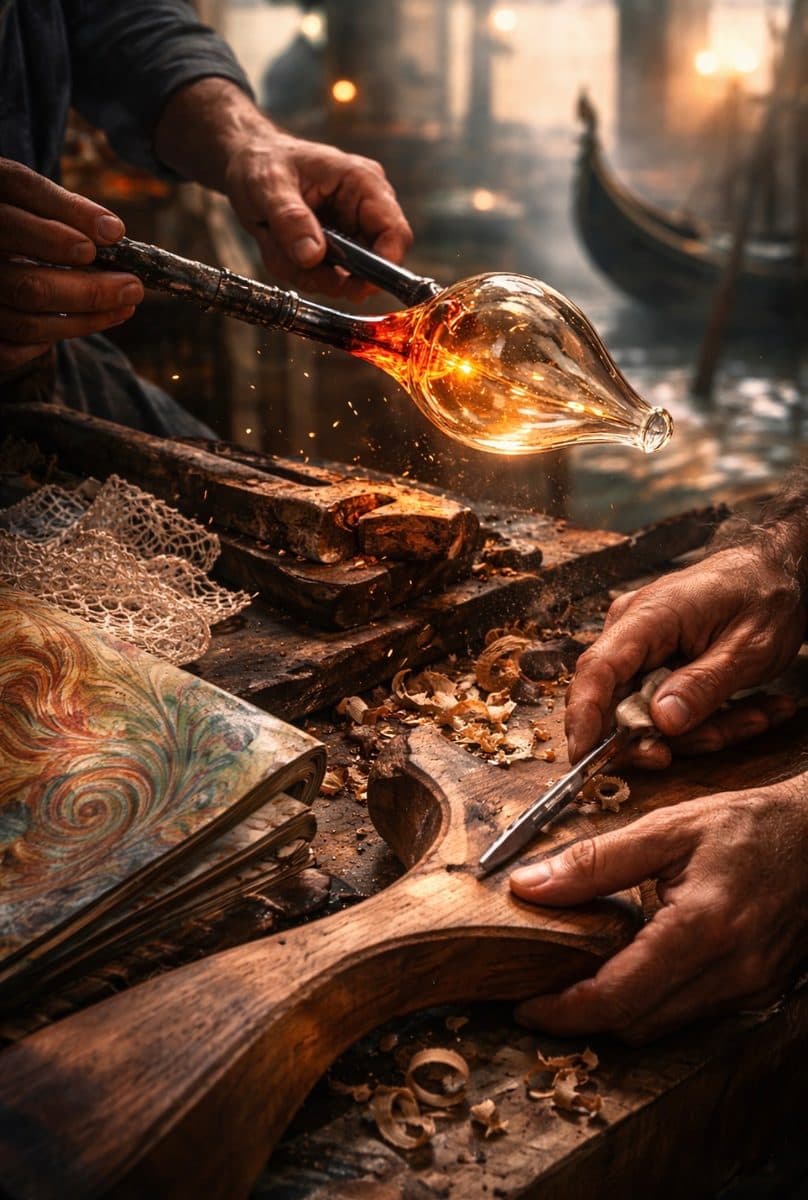
The Gaze of the Everyday Observer
The everyday observer looks at a city through simple objects: tools, sweets, and small handcrafted items born from the habits of its inhabitants.
In Venice, many souvenirs come directly from the city’s real activities: • publishing and artisan workshops • the domestic work of lace-makers • the cuisine of the lagoon islands.
By following these objects, it becomes possible to understand how people truly lived among calli and islands, between artisan work and community life.
Paper, Books and Workshops
Souvenir: marbled paper
From the 16th and 17th centuries, Venice was one of the main European centers of printing and publishing. Numerous printers and bookbinders worked in the city, producing books destined for international trade.
In this context, marbled paper spread, used to decorate book covers and endpapers. The technique consists of floating colored pigments on the surface of water and placing a sheet on top of the design to transfer it. 
The technique reached Europe through commercial contacts with the Middle East and found a place precisely in Venice, a city of exchange between East and West. 
This is why marbled paper exists here: because Venice was a capital of books and cultural trade.
Even today, it is produced in Venetian workshops for notebooks, journals, and covers.
The Lace Makers of the Island
Souvenir: Burano lace
A few kilometers from Venice, the island of Burano is famous for a highly complex form of craftsmanship: needle lace.
The first records of the trade in Venetian lace date back to the end of the 15th century. The Burano technique stands out because the embroidery is done using only needle and thread, without a fabric base (a technique called “punto in aria”). 
In 1872 the Burano Lace School was founded, with the aim of teaching the technique to the young women of the island and creating stable work for the community. 
This is why lace developed right here: Burano was a fishing community where women worked from home, producing lace intended for trade.
Even today some lace makers continue this artisanal practice.
Lagoon Biscuits
Souvenir: bussolà and esse from Burano
The cuisine of the lagoon includes many simple sweets designed to last over time.
Bussolà from Burano is a ring-shaped biscuit made with: • flour • butter • sugar • egg yolks. 
Traditionally it was baked by fishermen’s families. Because it keeps for a long time, it was well suited for fishing days or sea crossings. 
Over time, a variation with an elongated shape appeared: the esse from Burano, easier to dip in sweet wine or coffee. 
These biscuits exist right here because Burano has historically been a fishermen’s island, where simple foods that could be preserved were essential.
The biscuits of Venetian cafés
Souvenir: baicoli
Baicoli are thin, very dry biscuits typical of the Venetian tradition.
The name comes from the Venetian word baìcolo, which refers to a small fish from the lagoon: the biscuit’s long, narrow shape in fact resembles that of the fish.
Thanks to their dry texture, baicoli keep for a long time and were often served with zabaglione or coffee in Venice’s historic cafés.
In a city of trade and travel, where products had to last a long time, this type of biscuit was especially practical.
Conclusion
By following these souvenirs, three concrete aspects of Venetian life emerge: • the bookshops and book craft workshops, which explain the presence of marbled paper • the domestic work of lacemakers, tied to the community of Burano • the simple cooking of the islands, with biscuits designed to last over time.
These are not objects created for tourists. They are products that exist because Venice has been: • a city of artisans • a city of the sea • a city of cultural exchange.
By observing these small everyday objects, it becomes easier to understand how life in the Venetian lagoon truly worked.
Editorial content produced with AI assistance and reviewed by our editors. It may contain inaccuracies.
Free download
Take Trouvenir with you
iOS and Android. Free.
Privacy-firstCross-device syncOffline ready