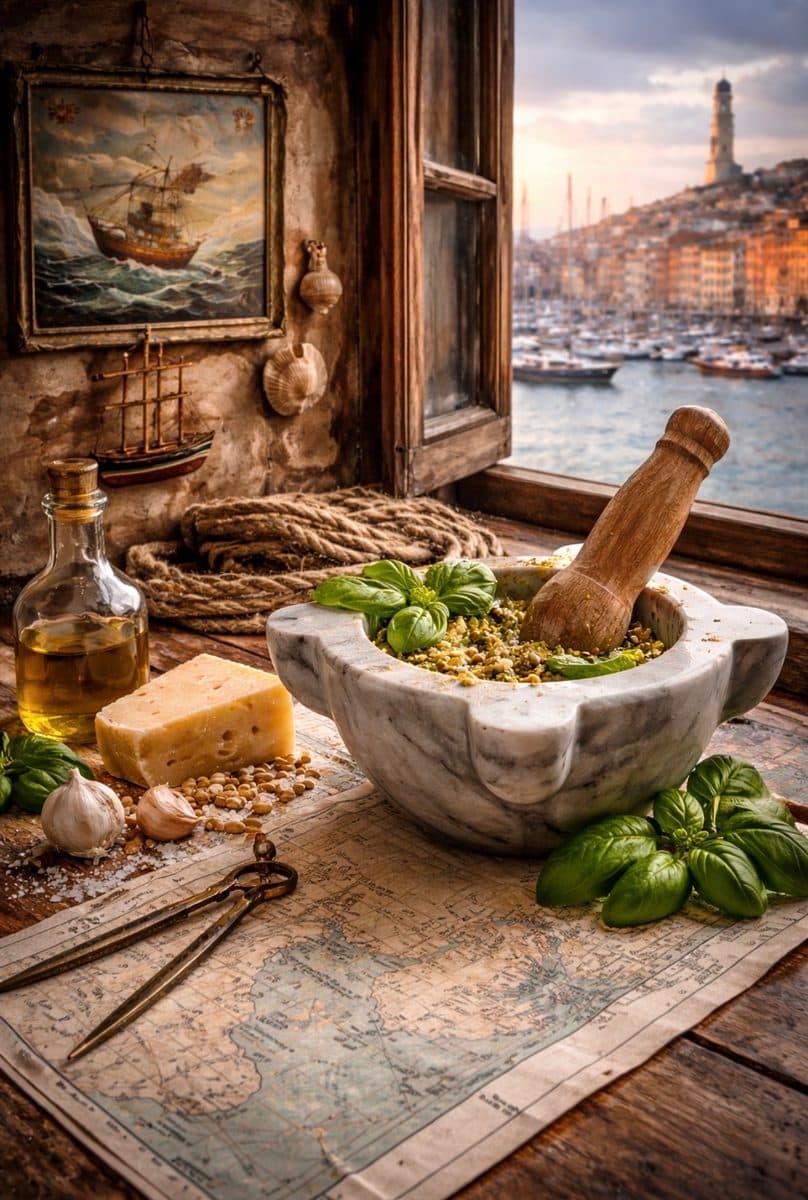
Genoa between sea, devotion, and cuisine: a journey through the city’s symbolic objects
Symbolic Explorer
The Symbolic Explorer’s Gaze
The symbolic explorer observes a city through objects that tell the story of its identity.
They are not simply looking for decorative souvenirs. They look for objects that explain how the city took shape, which activities sustained its economy, and how its inhabitants lived in their territory.
In Genoa many of these objects are born from the relationship with the sea. For centuries the city was a great commercial power of the Mediterranean, and even today its cultural landscape reflects this history.
Nautical charts, maritime votive offerings, basil grown on the hills, and marble mortars in the kitchens tell four dimensions of the same city: navigation, faith, agriculture, and cuisine.
The Sea and Fear: Sailors’ Ex Votos
Gli ex voto marinari sono documenti devozionali, spesso conservati nei santuari, non un oggetto da banco. Non sono nel catalogo verificato: una tavoletta dipinta senza provenienza non è un ex voto.
The basil of the hills of Prà
Related souvenir: • Genoese basil
Basil does not grow in the same way across all Mediterranean regions. Basilico Genovese is a particular variety grown mainly in the area of Prà, today a district of Genoa.
The mild climate, proximity to the sea, and the soils of the Ligurian hills favor a plant with small leaves and a delicate aroma.
This variety is now protected by the Basilico Genovese DOP designation, which defines the production area and the characteristics of its cultivation. 
For this reason, basil has become one of the most representative ingredients of the city.
It is not simply an aromatic herb: it is the result of a very specific agricultural environment, closely tied to the Ligurian coast.
Pesto and the mortar: Genoese home cooking
Voci collegate: • Pesto alla genovese • Mortaio in marmo per pesto
Il pesto alla genovese nasce nella cucina di casa a Genova. Non è una DOP, un’IGP né una STG. Una ricetta scritta compare in «La vera cuciniera genovese» (1852): basilico, aglio, pinoli, formaggi e olio.
Il verbo «pestare» spiega il nome. Gli ingredienti si lavorano in un mortaio di marmo con pestello di legno, così le foglie si schiacciano senza scaldarsi. Il basilico, se è Basilico Genovese DOP, e l’olio, se è Riviera Ligure DOP, restano denominazioni degli ingredienti.
A Genova si tiene il Campionato mondiale di pesto al mortaio, che mette in scena questa ricetta.
Conclusion — Objects That Tell the Story of the City
Guardando questi souvenir insieme emerge una storia coerente. • Le carte nautiche raccontano la Genova dei navigatori e dei commerci mediterranei. • Gli ex voto marittimi mostrano la vita quotidiana dei marinai e la loro devozione. • Il basilico rivela il rapporto tra la città e il suo territorio agricolo. • Il pesto e il mortaio raccontano la cucina domestica nata da questi ingredienti locali.
Oggetti molto diversi tra loro finiscono quindi per descrivere lo stesso paesaggio culturale: una città costruita tra porto, colline coltivate e uso locale marinara.
Attraverso questi oggetti, Genova non appare solo come un luogo da visitare, ma come una città in cui mare, cucina e vita quotidiana sono sempre stati strettamente collegati.
Contenu éditorial produit avec l'aide de l'intelligence artificielle. Il peut contenir des inexactitudes. Comment nous utilisons l'IA
Emportez Trouvenir avec vous
iOS et Android. Gratuit.